Meet The Trustees
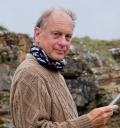
Peter Cowdrey is a UK based composer, pianist and ornithologist
with a particular interest in birdsong and recording. He is the founder
of Planet Birdsong, and its musical arm The Conference of Birds. As a
small boy he loved listening to the dawn chorus but was deeply
frustrated at birdsong's inaccessibility - too fast, too high, and
resolutely resistant to being shoehorned into what was generally
defined as music. Peter is excited that advances in technology have
made it possible to crack the hidden codes of birdsong and seeks to
share them with the rest of the world, especially children. Learn more in this
short BBC documentary.
Dr. Isak Herman, PhD brings over a decade of collaborative work
with marine, terrestrial and avian conservation organizations around
the world. With a background in computational acoustics, his subsequent
doctoral research, through the Department of Computer Science and
Technology at the University of Cambridge, UK, involved specialization
in design and development of public engagement technology for
bioacoustic education and citizen science. As a trustee of the Planet
Birdsong Foundation he specializes in web and mobile software development
with a focus on educational games. For past and ongoing research work,
find out more at
bioacoustic.games.
Some of the fieldwork for his
doctoral thesis was on Planet Birdsong’s work in schools and communities in Yorkshire.

Hilary MacBean is a retired UK Chartered Town Planner with an
interest in sustainable development practice who now focuses on
bird and wildlife conservation. She is leading the Planet Birdsong
Foundation partnership with the University of Rwanda Centre of
Excellence in Biodiversity and Natural Resource Management, is working
on appropriate bio-acoustic recording and processing techniques, and is
supporting the logistical and organisational side of the project. She
has visited Rwanda several times since 2015 and is involved in mentoring
and training young bird guides for international tourism while bringing
awareness and knowledge of bird sounds to guides and students. Her
underlying interests are in bird life conservation and data as an
indicator of biodiversity health, aimed at a holistic and sustainable
approach to conservation and community development.
Prof. Beth Kaplin has over 35 years of experience as a biodiversity
conservation scientist. She was appointed the founding Director of the Center
of Excellence in Biodiversity & Natural Resource Management (CoEB) at University
of Rwanda, a new governmental research institute at the time; she served from
2017 to 2023 during which time she successfully launched the Center and achieved
UNESCO Category 2 Center status for it. Beth is an Honorary Professor of Conservation
Science at University of Rwanda where she supervises student research and serves as
a senior researcher in the CoEB. She is also an affiliated Research Professor in the
School for the Environment at University of Massachusetts-Boston, US. She received
her BSc in wildlife biology from Colorado State University, and MSc and PhD in
Zoology from University of Wisconsin-Madison. From 2006 to 2015, she raised over
one million USD from the MacArthur Foundation for National University of Rwanda to
develop BSc and MSc programs in biodiversity conservation which put the institution on
the map for conservation biology training in Africa. She also created the Regional
Network for Conservation Educators in the Albertine Rift to support and empower conservation
scientists in Rwanda, Burundi, DRC, Tanzania, and Uganda with MacArthur Foundation support.
Beth maintains a research program on understanding tropical forest ecology, plant-animal
interactions, restoration processes, protected areas conservation, human-wildlife interactions,
and the relationships between ecosystem integrity and services, climate change, and nature-based
solutions. She has worked in Rwanda, Uganda, Central Africa Republic, DRC, Burundi and Costa Rica.
Her interests also focus on developing and strengthening science-policy linkages. She has published
over 70 peer-reviewed articles and book chapters and serves on several journal editorial boards.
While director of the CoEB, she oversaw the revitalization and digitization of the National
Herbarium of Rwanda which holds over 20,000 specimens, and the creation of the Rwanda
Biodiversity Information System, an open-access repository of biodiversity data serving policy
and research needs. Prof. Kaplin has focused her career on building capacity for biodiversity
conservation, biodiversity science, and climate adaptation, and has developed leadership skills
and extensive networks across the globe. In 2023 she won the Frankfurt Conservation Award from
the Bruno H. Schubert-Foundation for her contributions to applied research. She is currently
involved in ecosystem restoration in Indonesia, and biodiversity and climate adaptation projects
in Rwanda.
Tobias Masterton comes from a musical family and was a keen boy chorister.
He spent over 30 years in the British Army, United Nations and NATO, provided
evidence to international war crimes tribunals and served in the Balkans, Africa,
the Middle East and South-East Asia. He has extensive experience in conservation,
the illegal wildlife trade, modern slavery and human trafficking with postgraduate
qualifications from King’s College, London and Columbia University, New York. He
was executive director of Nobel Peace Laureate Archbishop Emeritus Desmond Tutu’s
global education campaign and remains an ambassador of the Tutu Foundation UK.
He’s a fellow of the Royal Society for the Arts, an associate member of the Centre
for Conflict and Health Research at King’s College, London and a member of the
English Speaking Union. He was a senior associate fellow with the Advanced Research
and Assessment Group at the Defence Academy of the United Kingdom, development
committee member of PAN Intercultural Arts, development director of a business and
arts initiative affiliated with the Commonwealth Youth Orchestra & Choir, senior
adviser to the world’s first diaspora remittances investment platform, and strategic
adviser to a technology group with unique potential to scale citizen science data
collection. He’s developing plans for a centre of excellence in food/water security
and climate resilience in a geostrategic African country. With an emphasis on young
people especially women and girls, this will enable civil society, NGOs and traditional
leaders to partner with academia, the private sector and philanthropic institutions.
Peter Murray Threipland is a Scottish Highlands based filmmaker with a
growing passion for birdsong. He works on Birdsong Studios in schools
and environmental projects across the UK with Planet Birdsong founder
Peter Cowdrey, working on the essential elements of sound design, recording
and editing that bring the studios to life. He is a keen traveller and
avid sailor, and eagerly looks forward to what the future holds for Planet
Birdsong.
Enathe Hasabwamariya, a native of Rwanda, is a nature conservationist with
more than 10 years of experience in biodiversity conservation. She holds an M.Sc
in Environmental Studies from Antioch University, USA, and a bachelor’s
degree in Conservation Biology from the former NUR (now UR). Enathe has a range of
experience working on Gorilla’ behavior from the Volcanoes National Park, chimpanzees
habituation in Nyungwe National Park and fisheries in Akagera National Park. she has
worked with multiple conservation organizations such as the Dian Fossey Gorilla Fund,
IGCP, World Wildlife Fund (WWF), Wildlife Conservation Society (WCS), African Parks
Network (APN) and the IUCN. Since 2019, Enathe is an Associate Programme Specialist at
UNESCO World Heritage Centre, in Paris, France. In her role, she is a focal point to
countries across the Eastern Africa region including Comoros, Djibouti, Ethiopia,
Eritrea, Kenya, Madagascar, Mauritius, Seychelles, South Sudan, Uganda, and Tanzania, where
she supports governments in implementing the 1972 World Heritage Convention.